How Much Gold Is in a Computer? CPU, RAM and Motherboard, Part by Part
A typical computer holds a fraction of a gram of gold, mostly on the motherboard and the RAM contacts. That’s tens of dollars of metal, and less as scrap.
Last updated: October 2026
Table of Contents
- How much gold is in each part
- Why there’s gold in a PC at all
- RAM: how many sticks make 1 gram of gold?
- Motherboards and graphics cards
- CPUs: high concentration, small amounts
- How much gold is in a whole desktop or laptop?
- What that gold is worth
- Why scrap buyers pay much less
- Can you extract the gold at home?
- What to do with your old parts instead
- Frequently Asked Questions
- Do hard drives and SSDs contain gold?
- Which has more gold, a phone or a laptop?
- Is gold the most valuable metal in computer scrap?
Pull a RAM stick out of an old PC and you’ll see a row of gold-colored contacts along the bottom edge. Same on the graphics card, same on the CPU pads. With gold trading around $4,000 an ounce, it’s fair to wonder what that box of retired parts in your closet is really worth.
It’s less than the shine suggests, but it isn’t zero. Below are the published amounts per part, how to turn grams into dollars at today’s price, and why a scrap buyer will pay you only a slice of that number.
How much gold is in each part
These are the best published figures available. Treat them as averages: two sticks of RAM from different factories can differ by more than a factor of two.
| Part | Gold | Where it sits |
|---|---|---|
| RAM stick (1991 to 2008 modules) | About 18 mg (10 to 27 mg) | Mostly the edge contacts |
| Motherboard | 0.1 to 0.5 g | Chips, slot contacts, plated pads |
| Whole laptop | About 0.22 g | Mainboard, memory, connectors |
| Mobile phone | About 0.034 to 0.038 g | Circuit board and chips |
| CPU, graphics card | Small, varies by generation | Plated pads, edge fingers, inside the chip |
| Hard drive, SSD | Small, no reliable figure | Controller chip, connector |
The RAM figure comes from a Waste Management study (Charles et al., 2017) that dissolved and measured modules made between 1991 and 2008. The motherboard range is the estimate given in a 2012 gold-recovery study of computer circuit boards (Journal of the Mexican Chemical Society); that study didn’t weigh the gold per board itself. The laptop and phone figures come from European recycling projections and the US EPA. I found no comparable public measurement for a single modern CPU or graphics card, so this page doesn’t invent one.
Why there’s gold in a PC at all
Gold doesn’t corrode. A contact that has to make a clean electrical connection for ten years, through dust, humidity and dozens of insertions, is exactly where you want a metal that won’t tarnish. That’s why you find it on contacts and inside integrated circuits, and much less anywhere else.
It’s also why the amounts are tiny. Manufacturers plate a thin layer of gold over cheaper copper instead of using solid gold. In standard consumer electronics that layer can be just a few atomic layers thick. Electronics from the 1980s to the early 2000s generally carry thicker gold than current hardware, so a beige tower from 1998 is a better scrap candidate than last year’s office PC.
Electronics are a real but small share of the gold market. The US Geological Survey estimates that electrical and electronic uses made up about 7% of global gold consumption in 2025, against 40% for jewelry.
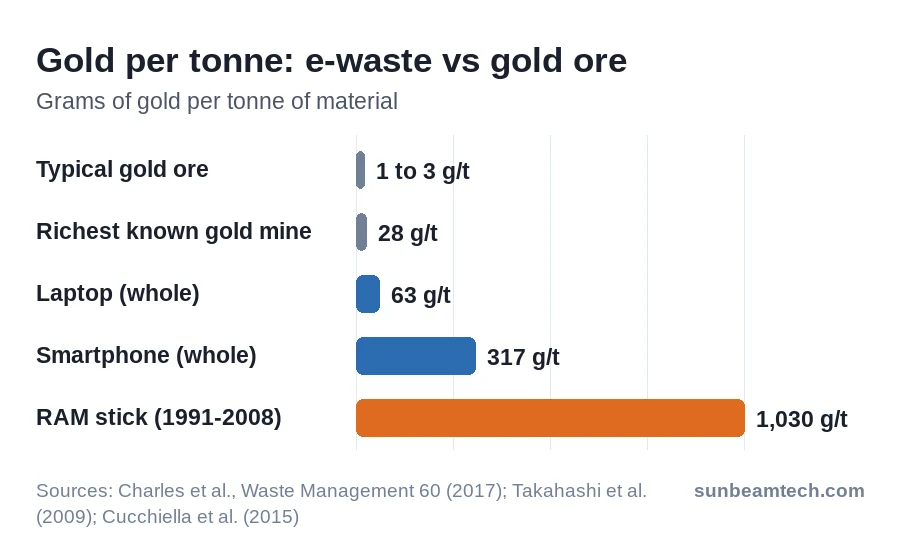
What makes e-waste interesting to refiners is concentration, not total weight. A mobile phone can be up to 0.04% gold by weight, or 400 grams per tonne. A typical gold ore runs 1 to 3 grams per tonne. Per kilo, a pile of phones is richer than the best gold mine on Earth, which runs about 28 grams per tonne.
RAM: how many sticks make 1 gram of gold?
About 55, if they’re sticks made between 1991 and 2008. That’s the era that has been measured. In the Swansea University study, the memory modules with gold contacts averaged 18.2 mg of gold each, with individual modules ranging from about 10 mg to 27 mg. At 18.2 mg per stick, you need roughly 55 sticks for one gram.
Three things from that study are worth knowing if you’re sorting a bin of old memory:
- The gold is in the edge contacts. Two old EDO SIMMs in the sample had tin contacts instead of gold, and their gold content was low. Look at the contacts: gold-colored fingers carry most of the gold, and the tin-contact modules held a third or less of the average.
- The amount didn’t drop over time. From SDR through DDR, DDR2 and DDR3, the contact area stayed about the same because manufacturers kept the module size and packed more memory onto it. Gold levels stayed stable; palladium fell by about 80% over the same years.
- RAM is richer than the boards around it. At about 1,030 parts per million, the modules held more gold per gram than most motherboards and expansion cards measured in other studies.
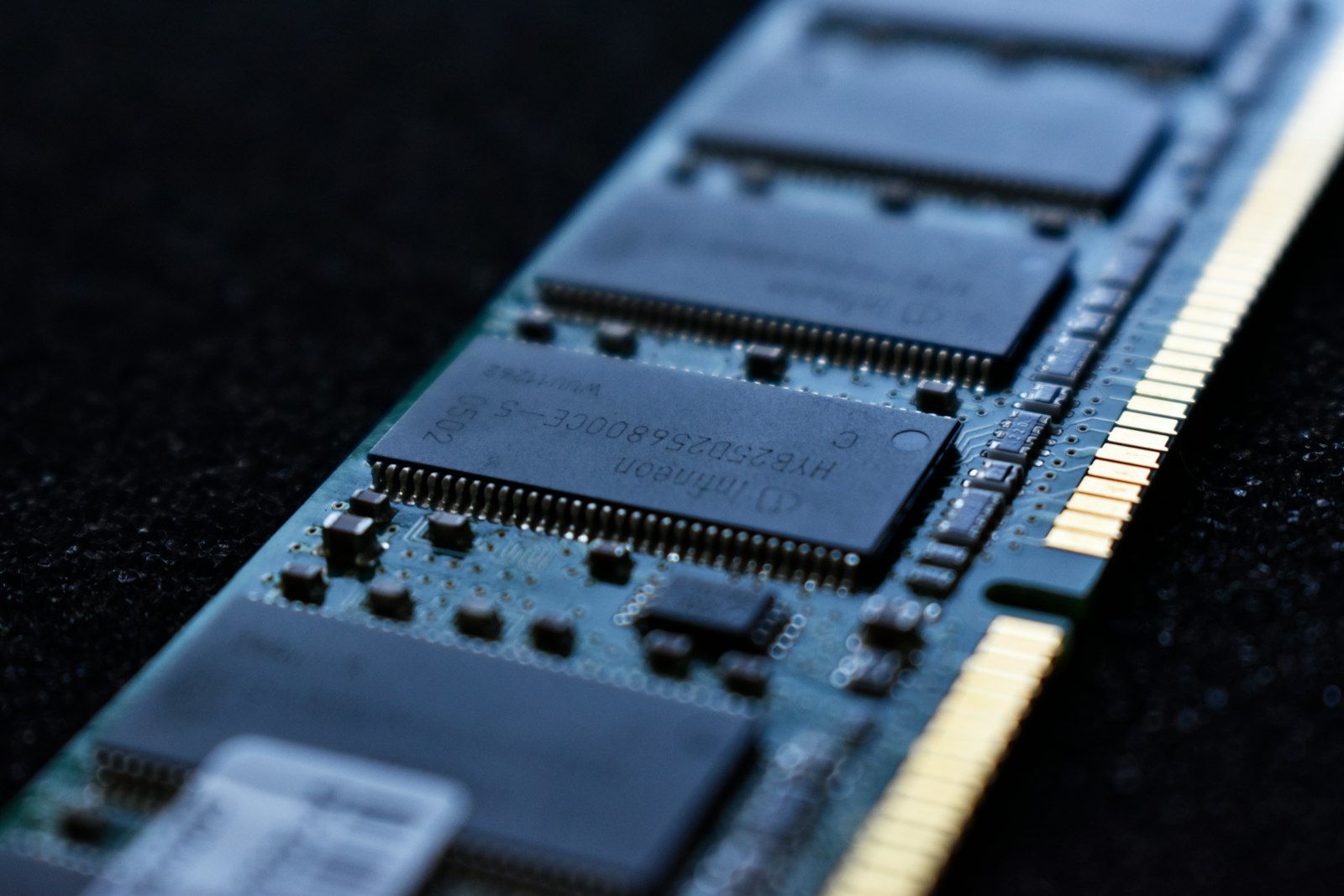
If by “RAM chips” you mean the black chips themselves: most of a module’s gold is in the edge contacts, not in those chips. DDR4 and DDR5 weren’t part of the sample, since it ends in 2008. They still use gold-plated contacts, but I found no published measurement of how much. If you want to know which generation you’re holding, our DDR4 vs DDR3 comparison covers how to tell them apart.
Motherboards and graphics cards
A computer motherboard holds roughly 0.1 to 0.5 grams of gold. It sits on the chips, the contacts inside the memory and expansion slots, and plated pads around the board. That’s more gold in total than a RAM stick, but spread over a much heavier board, so the concentration is lower.
Graphics cards and other expansion cards have the same kind of plated edge fingers you see on RAM, the strip that slides into the PCIe slot (the part you line up when you install a GPU). There’s no reliable public figure per card, so don’t count on one paying for anything.
CPUs: high concentration, small amounts
Per gram of material, processors are the richest part of a computer, because gold is used inside the chip as well as on its contacts. But a modern CPU weighs very little, and the gold-colored pads or pins on a current Intel or AMD chip are plating, not solid gold.
Old chips hold more. Electronics from the 1980s through the early 2000s used thicker gold layers than today’s, processors included, so an old CPU usually holds more than a new one. If you still have a working modern CPU, it’s worth far more as a processor: clean it with our thermal paste removal steps and sell it, or reuse it in a spare build following the CPU install guide.
How much gold is in a whole desktop or laptop?
For laptops there’s a decent number: about 0.22 grams per notebook, based on the European recycling projections used in the RAM study (for a laptop weighing about 3.5 kg).
For a desktop, add up the parts. One motherboard (0.1 to 0.5 g) plus two RAM sticks (about 0.04 g) comes to roughly 0.14 to 0.54 grams, before the small amounts in the CPU and graphics card. An older office PC with thicker plating and more slots filled can land higher.
The case, fans, cables and drive cages are steel, aluminum, copper and plastic. They’re worth something as scrap metal, but they add nothing on the gold side.
What that gold is worth
Gold is priced per troy ounce, and one troy ounce is 31.1 grams. To get the price per gram, divide the ounce price by 31.1. Then multiply by the grams in your part.
The price moves every trading day, so check a live gold price chart before you run the numbers. Here’s what the parts above contain at $4,000 an ounce, which works out to about $128.60 per gram:
| Part | Gold | Metal value at $4,000/oz |
|---|---|---|
| One RAM stick | 18.2 mg | About $2.34 |
| One motherboard | 0.1 to 0.5 g | About $13 to $64 |
| One laptop | 0.22 g | About $28 |
| 55 RAM sticks | About 1 g | About $129 |
That’s the value of the metal sitting in the part. It’s not what anyone will pay you for it.
Why scrap buyers pay much less
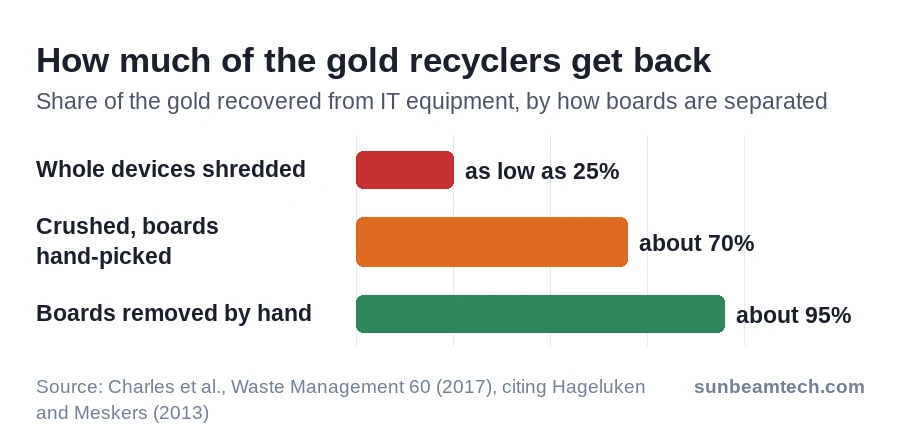
Getting gold out of electronics loses a lot of it along the way. When recyclers shred whole devices, the precious metals scatter into the wrong fractions, and studies have measured overall gold recovery as low as 25% for that route. Crushing devices and hand-picking the boards gets about 70%. Pulling the circuit boards out by hand first gets recovery up to about 95%, but someone has to pay for that labor.
On top of that, a refiner charges for processing and for the assay, the lab test that sets your payout. Assay labs test shredded, ground material because single parts give unreliable results. All of that comes out of the metal value before you see a cent, which is why small batches rarely make sense to sell for their gold.
Can you extract the gold at home?
Don’t. Separating gold from circuit boards means strong acids such as hydrochloric and nitric acid, which can burn and poison you if handled wrong. Professional recovery needs specialized equipment, ventilation and proper disposal of the leftover chemicals, and none of that fits in a garage.
Even the pros do this in a factory. The UK’s Royal Mint opened a plant in south Wales in 2024 that can process up to 4,000 tonnes of circuit boards a year, using a chemistry that works at room temperature. The recovered gold goes into its jewelry line. That’s the scale at which e-waste gold pays.
What to do with your old parts instead
- Sell or reuse anything that still works. A working RAM stick holds about $2 of gold. Check what it sells for used before you think about scrap.
- Wipe or pull your drives. Hard drives and SSDs carry your data. Wipe them, or take them out and keep them, before any PC leaves your house.
- Take out the battery. The coin cell on the motherboard goes to battery recycling, not with the board. Our CMOS battery guide shows where it sits and how to pop it out.
- Drop the rest at an e-waste recycler. Many electronics retailers and local governments run take-back programs, and boards collected that way can go to refiners that recover the gold properly.
- Look in the jewelry drawer instead. If what you really want is money from gold, 14k jewelry is 58% gold, so a broken 3-gram chain holds about 1.75 grams. That’s more than three desktops’ worth. A dealer like GoldUnion, which buys and sells gold and silver at its branches in California, pays for that kind of gold by weight and purity.
Frequently Asked Questions
Do hard drives and SSDs contain gold?
Yes, a little. Both use gold in their controller chips and on the interface connector. The amounts are small, and the drive’s value to you is the data on it, so wipe or keep it before it goes anywhere.
Which has more gold, a phone or a laptop?
A laptop has more in total, about 0.22 g against roughly 0.038 g for a smartphone. Per kilo it flips: a phone weighs about 120 g, which works out to around 317 grams of gold per tonne, while a 3.5 kg laptop comes to about 63 grams per tonne.
Is gold the most valuable metal in computer scrap?
Yes. In the RAM study, gold made up about 93% of the metal value in waste memory modules, far ahead of palladium, silver and copper combined. Across e-waste recycling in general, more than 80% of the recovered material value has been attributed to gold alone.

Alex has been building and tweaking custom PCs for over 12 years. From budget builds to full custom water loops, he’s assembled more than 50 systems and helped hundreds of builders troubleshoot their rigs. When he’s not benchmarking the latest hardware, you’ll find him optimizing airflow setups or stress-testing overclocks.