PC vs Console in 2026: Is PC Gaming Still Worth It?
PC gaming offers superior graphics, modding support, and long-term upgradability, while consoles provide lower upfront cost, simplicity, and a consistent plug-and-play experience.
Last updated: April 2026
Table of Contents
- The Cost Myth That Won’t Die
- Performance: The Gap Is Real, But It Depends on Resolution
- Game Libraries: More Complex Than You Think
- Specific Game Situations Worth Knowing
- Upgradability: PC’s Biggest Long-Term Advantage
- Convenience: The One Area Consoles Genuinely Win
- Game Pass: The Subscription Wild Card
- Sim Racing: A Clear PC Edge
- The Online Experience Comparison
- The PC Master Race Meme, and Why It Misses the Point
- Who Should Buy a Console in 2026
- Who Should Build or Buy a Gaming PC in 2026
- Frequently Asked Questions
- Is PC gaming still worth it in 2026 given hardware prices?
- How many PC gamers are there compared to console gamers?
- Is GTA 6 releasing on PC at the same time as console?
- Which platform is better for online multiplayer, PC or console?
- Do sports games like Madden and NBA 2K play better on console or PC?
- The Short Version
Most people think the PC vs console debate is simple: PCs are more powerful, consoles are cheaper, pick your side. They’re wrong. Or at least, they’re only half right. In 2026, that framing misses what’s actually happening in gaming. Prices have shifted, the performance gap has narrowed at certain price points, and platform exclusives keep reshuffling the deck. The real question isn’t “which is better?” It’s “which is better for you, right now, given what you’re willing to spend?”
Let me break it down honestly, without the tribalism.

- 🟢 PC wins on: Graphics ceiling, modding, backward compatibility, multi-use hardware, free online gaming
- 🟡 Console wins on: Upfront simplicity, couch gaming, exclusive titles, lower short-term entry cost
- 🔴 Both struggle with: Pricing in 2026. GPU costs, PS5 Pro pricing, and tariff-driven hardware inflation are hurting everyone right now.
The Cost Myth That Won’t Die
Everyone says consoles are cheaper than gaming PCs. And on a pure day-one sticker price comparison, they often are. A PS5 runs around $499, and you’re gaming within an hour of unboxing it. But that “cheaper” narrative falls apart the moment you zoom out past six months.
Console games typically cost $69-$70 at launch in 2026, with no meaningful competition to keep prices in check. PC games on Steam regularly drop 50-75% within a year. If you buy five games a year, you’re looking at $345+ on console. On PC? You might spend half that on the same titles. Over three to four years, that gap compounds fast.
Then there’s online multiplayer. Xbox and PlayStation both charge for online access. PlayStation Plus runs $79.99 per year for the basic tier. PC multiplayer is free. No asterisk, no subscription tier required. That’s another $80 annually back in your pocket on PC.
32GB of RAM now costs nearly as much as a budget console game used to, and mid-range GPU prices have climbed significantly due to supply chain pressures and tariff impacts in 2026. That’s the new reality. Building a mid-range gaming PC that comfortably beats a PS5 or Xbox Series X will cost you $900-$1,200 right now, depending on your region. Not cheap. But when you factor in free online, cheaper games, and the fact that a well-built PC doesn’t need replacing for five-plus years, the long game still favors PC for most enthusiast builders.
Performance: The Gap Is Real, But It Depends on Resolution

Here’s where PC gaming genuinely shines, and where console marketing genuinely misleads.
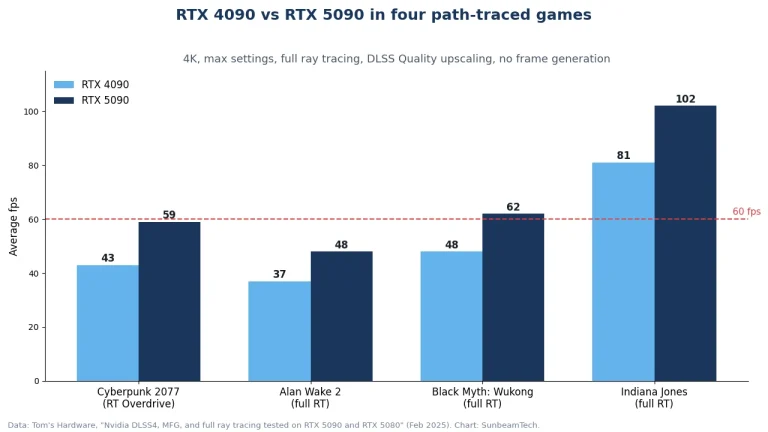
Current-gen consoles target 4K/60fps or 1440p/120fps in their performance modes. They hit those targets inconsistently, with dynamic resolution scaling doing a lot of heavy lifting behind the scenes. A mid-range GPU like an RTX 4070 hits those same targets more consistently, with higher texture quality settings and better shadow rendering. A high-end build with an RTX 4080 or 4090 runs in a different league entirely.
At 1080p, the comparison gets tighter. A PS5 at 1080p looks excellent. A $600 PC build at 1080p looks similar, sometimes better, sometimes not. The visual fidelity gap only becomes obvious at higher resolutions and with features like ray tracing, DLSS, or FSR enabled at quality settings consoles can’t sustain.
PC also gives you direct control over your GPU’s behavior. You can monitor thermals, adjust fan curves, and keep an eye on whether your hardware is running efficiently. Understanding safe GPU temperature ranges matters when you’re pushing a card hard in demanding titles, something console users never need to think about because the system manages it invisibly.
Game Libraries: More Complex Than You Think
Console exclusives used to be the trump card. Sony’s first-party output remains genuinely strong: the God of War series, Spider-Man games, Horizon titles. These are excellent games that console-only players can access first. But Sony has been steadily porting its exclusives to PC within 12-24 months of release, so “exclusive” increasingly means “timed exclusive.”
Xbox flipped its exclusivity strategy entirely. Every Xbox first-party game ships on PC on day one. If you’re a Halo, Forza, or Avowed fan, you don’t need an Xbox console at all. A Windows PC already has you covered.
Then there’s the PC-only territory. Mods. Strategy games. Simulation games like Planet Zoo and Planet Coaster, which feel fundamentally different on PC than their stripped-down console versions. Crusader Kings 3 on console is a notable example: reviewers consistently found the console version to be a significantly worse experience than PC due to the interface constraints. Deep management games simply weren’t built for controllers.
Games like Rust, DayZ, and 7 Days to Die also differ meaningfully between platforms. Rust’s PC map sizes dwarf the console version. DayZ on PC has a more active modding scene and more server options. If those games are on your list, PC isn’t just an option, it’s the better version.
Minecraft deserves a separate mention. The PC (Java) edition and the console/Bedrock edition are different enough that they feel like distinct games to dedicated players. Java edition has deeper mod support and has been the primary platform for technical Minecraft communities for over a decade.
Specific Game Situations Worth Knowing
Some games have release date differences between platforms that matter for timing decisions.
| Game / Situation | PC Status | Console Status |
|---|---|---|
| GTA 6 | PC release expected later (Rockstar’s typical pattern, as with GTA 5) | PS5/Xbox Series X day one |
| Battlefield 6 | Simultaneous release, higher settings, mouse/keyboard advantage | Controller-optimized, crossplay available |
| Arc Raiders | Primary platform, crossplay with console | Crossplay supported |
| Madden / NBA 2K26 | Available, but historically console gets more development attention | Primary platforms for these titles |
| Borderlands 4 | Simultaneous release across platforms | Simultaneous release |
Sports games like Madden and NBA 2K are a genuine area where console holds an advantage. These franchises historically prioritize console versions for feature depth and performance consistency. If sports games are your main genre, this matters.
Upgradability: PC’s Biggest Long-Term Advantage

This one’s simple. When a console generation ends, your hardware ends with it. You buy the new box or you’re left behind. PC hardware doesn’t work that way.
A PC built in 2022 with an RTX 3080 still plays modern games at high settings. You can drop in a new GPU without touching anything else. Upgrade RAM, add storage, swap out a CPU when you move to a new socket. You control the upgrade pace, and you control the budget timing.
Console “upgrades” like the PS5 Pro cost $699 and offer incremental gains over the base PS5. That’s a lot of money for a system that still won’t outperform a well-specced PC. The PS5 Pro’s improvements are real, but a PC user in the same price range can build something noticeably more capable.
Keeping an eye on your CPU temperatures under load is part of PC ownership, but it’s not complicated once you know the baselines. Understanding what good CPU temp ranges look like under gaming workloads helps you catch potential cooling issues before they affect performance or stability. You can read that full breakdown at Tom’s Hardware’s revenue visualization.
That’s not a small detail. It means PC gaming isn’t a niche. It’s the dominant platform by revenue, driven partly by the sheer variety of available titles, the active digital storefronts (Steam, Epic, GOG), and the massive PC-first genres like strategy, simulation, and MMOs.
In terms of active player counts, Steam alone regularly reports over 30 million concurrent users. The combined player base across PC and console is enormous, and crossplay has made platform tribalism increasingly irrelevant for multiplayer titles. You’re likely playing with and against people on different platforms already, whether you know it or not.
Convenience: The One Area Consoles Genuinely Win
No arguments here. Plug in, update, play. Console setup takes 20 minutes. You don’t need to know what a driver update is. You don’t need to troubleshoot why a game won’t launch because your BIOS settings aren’t configured right. You definitely don’t need to worry about your GPU running hot.
Console gaming works reliably for people who don’t want to think about the hardware. That’s not an insult. It’s a legitimate reason to choose a console. If you’re buying a gaming system for a family member, a kid, or someone who just wants to game without any of the PC learning curve, a console is the honest recommendation.
Controllers are also genuinely better for certain game types. Racing games, sports games, action RPGs, fighting games, and platformers often feel more natural with a controller. PC gaming supports controllers fully (Xbox controllers work natively on Windows), so you’re not forced into keyboard and mouse. But consoles are optimized around that input method from the ground up.
Game Pass: The Subscription Wild Card
Xbox Game Pass is available on both PC and console, but there are differences worth knowing. The PC version of Game Pass doesn’t include EA Play at the lower tier without an upgrade. Some games in the library are console-only and won’t appear in the PC catalog. If Game Pass is central to your gaming budget strategy, check the catalog availability for your preferred platform before committing.
On the flip side, having Game Pass on PC means you can combine subscription gaming with Steam purchases, Epic Games free titles, and GOG. No console subscription gives you access to that breadth of options. The PC ecosystem is fundamentally more open.
Sim Racing: A Clear PC Edge
This one’s not close. If sim racing is your thing, PC is the only serious platform. Titles like iRacing, Assetto Corsa Competizione, and rFactor 2 are PC-first (or PC-only) experiences. Wheel and pedal peripheral support is dramatically better on PC. The modding communities for sim racing games on PC produce content that console versions simply don’t have access to. Not even a debate.
The Online Experience Comparison
| Feature | PC | Console |
|---|---|---|
| Multiplayer cost | Free (no subscription required) | $60-$80/year (PS Plus / Xbox Game Pass Core) |
| Server options | Community servers, dedicated servers, private hosting | Publisher-controlled matchmaking primarily |
| Crossplay | Available in most major multiplayer titles | Available in most major multiplayer titles |
| Input method in competitive games | Mouse/keyboard advantage in shooters | Aim assist compensates in most titles |
The PC Master Race Meme, and Why It Misses the Point
The “PC master race vs console peasants” framing is old. Tired. And it actively poisons the conversation for people genuinely trying to decide what to buy.
The reality is that both platforms deliver good experiences. PC delivers the highest ceiling. Consoles deliver the lowest barrier to entry. Neither platform “won.” The market data backs this up: both generate substantial revenue, both have massive active communities, and many serious gamers own both.
If someone tells you console gaming is dead or PC gaming is too complicated to be worth it, they’re working with an agenda, not data. PC gaming is more accessible than it’s ever been, and console gaming isn’t going anywhere. The overlap between platforms, via crossplay and cross-buy programs, is only increasing.
The gaming industry’s direction in 2026 is clear: the platform wars are softening. Publishers want your money regardless of what box you’re playing on. That’s actually good for consumers.
For more context on how PC hardware performs under real gaming loads, Steam’s Hardware Survey provides a real-world snapshot of what GPUs, CPUs, and RAM configurations the active PC gaming population is actually running. It’s useful context when you’re deciding whether a certain build tier is worth targeting.
AMD and NVIDIA both publish performance documentation for their GPU lineups if you want to compare raw specs: AMD GPU product specs and NVIDIA GeForce lineup specs are worth checking before any PC build decision.
Who Should Buy a Console in 2026
- You want a plug-and-play experience with zero setup friction.
- Your priority genres are sports games, action games, or PlayStation exclusives.
- You’re buying for a child or a household where technical troubleshooting isn’t realistic.
- Your budget is strictly under $600 and you want gaming within a week, not a build project.
- You primarily game on a TV from a couch, and that setup matters to your enjoyment.
Who Should Build or Buy a Gaming PC in 2026
- You want the best possible visuals at 1440p or 4K.
- Your favorite genres include strategy, simulation, MMOs, or modded sandbox games.
- You care about free online multiplayer and the long-term savings that come with PC game pricing.
- You want a machine that does more than game: content creation, streaming, work, video editing.
- You’re willing to learn the basics of PC hardware management and enjoy having control over your setup.
- You play games like Rust, DayZ, or sim racing titles where PC is meaningfully the better version.
Frequently Asked Questions
Is PC gaming still worth it in 2026 given hardware prices?
Yes, but you need to be realistic about upfront cost. Building a PC that clearly outperforms current-gen consoles costs $900-$1,200 in 2026. The long-term savings on game prices and free online multiplayer make up that difference over two to three years for most players, but the initial investment is higher than it was in 2021-2022.
How many PC gamers are there compared to console gamers?
Estimates vary significantly depending on how you count platform users, but Steam alone reports over 130 million active accounts, with regular concurrent peaks above 30 million. Console active user bases across PS5 and Xbox Series combined are in a similar range globally. Mobile dwarfs both by a wide margin in raw user numbers, though PC leads in revenue per player.
Is GTA 6 releasing on PC at the same time as console?
Based on Rockstar’s historical pattern with GTA 5, which launched on consoles in 2013 and didn’t reach PC until 2015, GTA 6 launches on PS5 and Xbox Series X|S on 19 November 2026, with no PC version announced. Red Dead Redemption 2 took just over a year to reach PC, GTA 5 about 19 months. We cover what that means for a build in GTA 6 on PC: what to build for while no system requirements exist.
Which platform is better for online multiplayer, PC or console?
PC wins on cost since you don’t pay a subscription for online access. Console wins on simplicity since matchmaking is more standardized. For competitive shooters, PC players using mouse and keyboard have a precision advantage, which is why many crossplay games separate input methods or offer the option. For casual multiplayer and co-op, the platform difference is minor.
Do sports games like Madden and NBA 2K play better on console or PC?
Honestly? Console. Sports games like Madden and NBA 2K are developed with console as the primary platform. PC versions historically receive less optimization attention, can have feature gaps at launch, and the community is more active on console. If sports gaming is your main use case, console is the straightforward recommendation.
The Short Version
PC gaming still wins on raw performance, long-term value, game library depth, and flexibility. Consoles still win on simplicity, upfront accessibility, and sports game optimization. Neither platform is dying. Both are more expensive than they should be in 2026. If you game seriously across multiple genres and want the best experience over a five-year horizon, build a PC. If you want to game tonight with zero friction and sports games are your thing, get a console. The choice has always been about your situation, not some objective ranking. Pick accordingly.

Alex has been building and tweaking custom PCs for over 12 years. From budget builds to full custom water loops, he’s assembled more than 50 systems and helped hundreds of builders troubleshoot their rigs. When he’s not benchmarking the latest hardware, you’ll find him optimizing airflow setups or stress-testing overclocks.