Most Graphically Demanding PC Games 2026 (Benchmarks and GPU Guide)
The most graphically demanding PC game right now is 007 First Light with path tracing, dropping an RTX 5090 below 25 fps at native 4K.
Last updated: September 2026
Table of Contents
- How This List Was Built
- What Makes a PC Game “Graphically Demanding”?
- Path tracing
- VRAM pressure
- Engine and streaming load
- Upscaling is now part of the design
- The 10 Most Graphically Demanding PC Games Right Now
- 1. 007 First Light (path tracing update)
- 2. Cyberpunk 2077 (RT Overdrive)
- 3. Resident Evil Requiem
- 4. Crimson Desert
- 5. Alan Wake 2
- 6. Control Resonant
- 7. Doom: The Dark Ages (path tracing)
- 8. Black Myth: Wukong
- 9. Indiana Jones and the Great Circle
- 10. Microsoft Flight Simulator 2024
- Honorable mentions
- Games With Path Tracing in 2026
- AMD vs NVIDIA: The Path Tracing Gap
- What Can a Mid-Range GPU Actually Handle?
- Should You Upgrade Your GPU for These Games?
- The Most Demanding PC Games Through the Years
- Frequently Asked Questions
- What is the most demanding PC game right now?
- What is the hardest game to run on PC?
- Which PC game has the highest system requirements in 2026?
- Can an RTX 5090 run every game at native 4K?
- Which games have path tracing?
- Is Borderlands 4 demanding or just badly optimized?
- What is the most graphically demanding game of all time?
- Do I need a new GPU to play these games?
- Final Thoughts
22 fps. That’s what an RTX 5090, the fastest gaming GPU you can buy, drops to in 007 First Light at native 4K with path tracing on and no upscaling. Cyberpunk 2077 isn’t far behind, and a handful of 2025 and 2026 releases now sit in the same “flagship GPU, still not enough” bracket.
This guide ranks the games that are genuinely hardest to run right now, explains why each one hurts, and shows what the numbers look like on real hardware, including the mid-range cards most of you actually own.
Quick answer: the hardest PC games to run in 2026
- 🔴 007 First Light (path tracing): RTX 5090 at 22 to 25 fps, native 4K
- 🔴 Cyberpunk 2077 (RT Overdrive): RTX 5090 can’t average 30 fps at native 4K max
- 🔴 Resident Evil Requiem (path tracing): RTX 5090 at 24 to 27 fps, native 4K
- 🔴 Crimson Desert (max lighting + Ray Reconstruction): RTX 5090 at 34 fps, native 4K
- 🟡 Doom: The Dark Ages (path tracing): RTX 5090 at roughly 35 fps, native 4K
- 🟡 Control Resonant: RTX 5090 at 48 fps, native 4K with only medium RT
- 🟢 Good news: with DLSS or FSR upscaling, most of these become playable on high-end cards
How This List Was Built
Let’s be upfront about the method, because a lot of “most demanding games” lists aren’t. The numbers in this guide come from published, independent benchmarks: Tom’s Hardware, TechPowerUp, TechSpot, DSOGaming, PC Gamer, Notebookcheck and GameGPU. Every figure links to its source so you can check the test setup yourself. We didn’t run these benchmarks on our own bench, and where outlets tested different scenes or settings, we say so rather than mashing the numbers together.
The ranking criteria are simple:
- Native 4K at max settings is the stress test. Upscaling and frame generation are great for playing, but they hide how hard the GPU is actually working.
- Real games with independent benchmarks. Tech demos and unreleased titles without published testing don’t count, no matter how good the trailer looks.
- Demanding isn’t the same as badly optimized. A game that needs a flagship GPU because it’s path tracing every light bounce is a different story from one that runs poorly because of engine problems. We flag the difference.
What Makes a PC Game “Graphically Demanding”?
Not every great-looking game is hard to run. Strong art direction can look incredible on a mid-range card. The games on this list are heavy for specific technical reasons.
Path tracing
Standard rasterization fakes lighting. Ray tracing adds physically based effects like reflections or shadows on top. Path tracing (often labeled “full ray tracing”) simulates light for the whole scene, bouncing rays around to calculate lighting, shadows and reflections together. It looks fantastic and it’s brutally expensive. In Doom: The Dark Ages, turning path tracing on cuts an RTX 5090’s native 4K frame rate by around 61%, from roughly 90 fps to 35 fps.
VRAM pressure
Ray tracing data, high-resolution textures and frame generation all live in video memory. Run out and you get stutter, texture pop-in, or worse. In Tom’s Hardware’s Indiana Jones testing, the 16 GB RTX 5080 and RTX 4080 Super effectively ran out of VRAM at 4K with full RT and frame generation enabled. The 5080 locked up; the 4080 Super dropped to 18 fps.
Engine and streaming load
Big open worlds with dense geometry and long draw distances (Crimson Desert, Flight Simulator) stress the whole system, not just the GPU. Unreal Engine 5’s Lumen lighting is itself a form of ray tracing, which is why UE5 games like Black Myth: Wukong and Borderlands 4 are so heavy even without a dedicated path tracing mode.
Upscaling is now part of the design
DLSS, FSR and XeSS render at a lower internal resolution and reconstruct the image. For path-traced games, they’re no longer optional extras. Frame generation adds smoothness on top, but it can’t fix a low base frame rate. Tom’s Hardware’s Jarred Walton puts the practical floor at roughly 40 fps before frame generation if you want it to feel decent.
The 10 Most Graphically Demanding PC Games Right Now
| # | Game | PC release | What makes it heavy | Worst-case data point |
|---|---|---|---|---|
| 1 | 007 First Light | May 2026 (path tracing: Sep 2026) | Full path tracing on the Glacier engine | RTX 5090: 22 to 25 fps, native 4K PT |
| 2 | Cyberpunk 2077 (RT Overdrive) | 2020 (Overdrive: Apr 2023) | Full path tracing across a dense city | RTX 5090: under 30 fps, native 4K max |
| 3 | Resident Evil Requiem | Feb 2026 | Path tracing on the RE Engine | RTX 5090: 24 to 27 fps, native 4K PT |
| 4 | Crimson Desert | Mar 2026 | Huge open world, max lighting + Ray Reconstruction | RTX 5090: 34 fps, native 4K max |
| 5 | Alan Wake 2 | Oct 2023 | Full path tracing, Northlight engine | RTX 5090: 48 fps at 4K even with DLSS Quality |
| 6 | Control Resonant | Sep 24, 2026 | RT global illumination with path tracing built into its RT presets | RTX 5090: 48 fps, native 4K with medium RT |
| 7 | Doom: The Dark Ages | May 2025 (path tracing: Jun 2025) | id Tech 8 path tracing | RTX 5090: ~35 fps, native 4K PT |
| 8 | Black Myth: Wukong | Aug 2024 | Unreal Engine 5 plus full ray tracing | RX 7900 XTX: 9.2 fps at 4K with upscaling |
| 9 | Indiana Jones and the Great Circle | Dec 2024 | Mandatory hardware RT, optional path tracing, VRAM-hungry | 16 GB cards run out of VRAM at 4K with full RT + frame gen |
| 10 | Microsoft Flight Simulator 2024 | Nov 2024 | Streamed planet-scale world, CPU and GPU both loaded | Only 1 of 23 GPUs hit 60 fps at native 4K ultra (RTX 50 not yet out) |
Sources for every figure are linked in the game sections below.
1. 007 First Light (path tracing update)
IO Interactive’s Bond game launched in May 2026 without hardware ray tracing, and it already looked great rasterized. Then the path tracing patch landed in September, and it jumped straight to the top of this list.
GameGPU measured an RTX 5090 at 22 to 23 fps in an open outdoor scene at native 4K with path tracing and DLAA, with the game using around 17 GB of VRAM. DSOGaming saw an RTX 5080 manage just 14 to 15 fps at native 4K on Path Tracing High, rising to 33 to 38 fps with DLSS Performance.
IO Interactive’s own path tracing requirements tell the story: an RTX 5070 for native 1080p at 60 fps on PT Medium, an RTX 5080 for 1440p, and an RTX 5090 for 4K on PT High. That’s the steepest official spec sheet of any game on this list.
2. Cyberpunk 2077 (RT Overdrive)
Cyberpunk’s RT Overdrive mode arrived in April 2023 and it’s still the benchmark everyone reaches for. Path tracing across a dense, neon-soaked city is about as hard as real-time rendering gets.
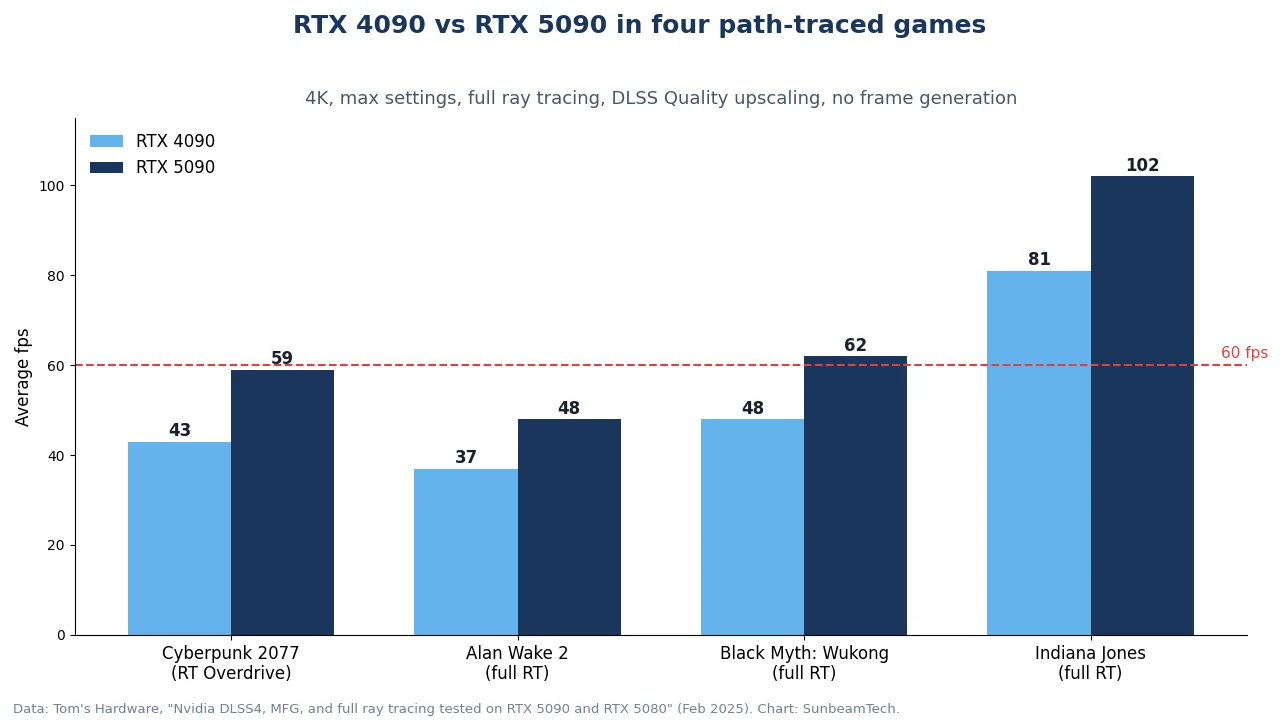
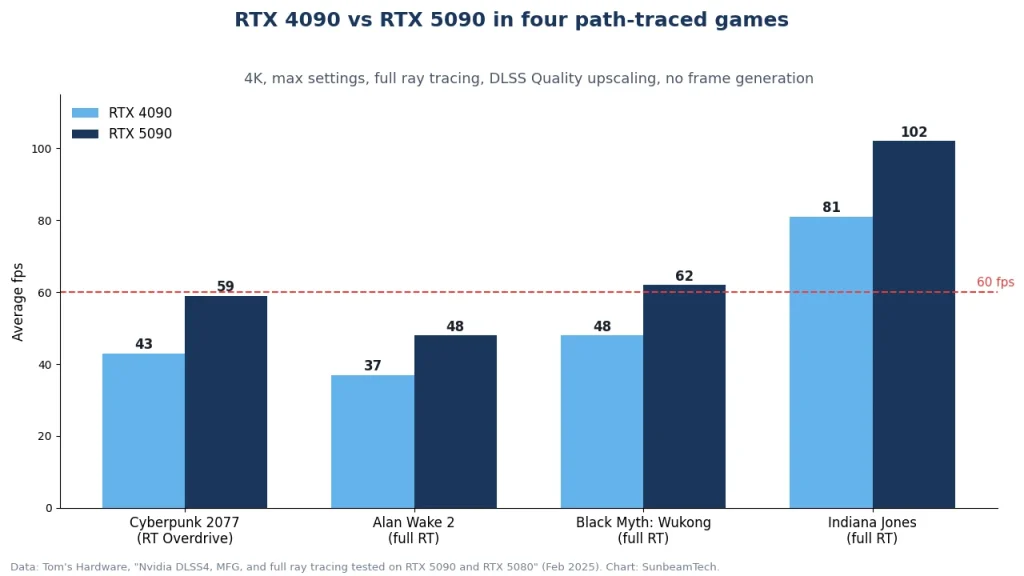
At native 4K with everything maxed, even the RTX 5090 couldn’t maintain a 30 fps average in early testing. With DLSS Quality upscaling and Ray Reconstruction, Tom’s Hardware measured 59 fps on the RTX 5090, 43 on the RTX 4090, 32 on the RTX 4080 Super and 16 on the RX 7900 XTX. The RTX 5080 was only about 12% faster than the 4080 Super.
So even upscaled, only one card gets near 60 fps without frame generation. That’s why Cyberpunk keeps its spot.
3. Resident Evil Requiem
Capcom’s February 2026 release supports path tracing from day one, and it’s a good example of how much the setting costs. On an RTX 5090, DSOGaming measured a minimum of 120 fps at native 4K without any ray tracing, 60s with ray tracing, and 24 to 27 fps with path tracing and DLAA. DLSS Performance mode lifted path tracing to a 53 fps average, a solid base for frame generation.
Drop to 1080p and it’s far more approachable. Notebookcheck’s desktop RTX 4080 ran max settings with path tracing and DLSS Balanced at 75.6 fps.
4. Crimson Desert
Pearl Abyss’s open world launched in March 2026 and behaves differently from the path-traced games above. DSOGaming found its standard ray tracing effects surprisingly lightweight, and TechSpot measured 110 fps on the RTX 5090 and 82 fps on the RTX 4090 at native 4K, with no Radeon card reaching 60.
The heavy part is the top of the settings menu. With maximum lighting and Ray Reconstruction at native 4K, GameGPU recorded 34 fps on the RTX 5090, 25 on the RTX 4090 and 19 on the RTX 5080. Gamers Nexus found that pushing past the Cinematic preset to fully maxed settings cost around 70% of the performance. VRAM is surprisingly modest: TechPowerUp measured about 12 GB at 4K even fully maxed with 4x frame generation.
5. Alan Wake 2
Remedy’s 2023 horror game remains one of the hardest path-traced games to run. In Tom’s Hardware’s 4K testing with DLSS Quality upscaling, the RTX 5090 managed 48 fps, the RTX 4090 37 fps, the RTX 5080 29 fps and the RTX 4080 Super 26 fps. The RX 7900 XTX managed 12.5 fps, partly because the game only supported FSR 2 at the time of testing, so AMD cards got no frame generation help.
The saving grace: it’s a slow, methodical game, which makes it one of the better cases for frame generation.
6. Control Resonant
Remedy’s sequel launches on September 24, 2026, and TechPowerUp’s launch benchmarks are already out. The game builds global illumination and path tracing into its ray tracing presets. At native 4K with only medium ray tracing and no upscaling, TechPowerUp measured 48 fps on the RTX 5090, with the RTX 5080 below 30 fps. At 1080p Ultra with ray tracing, you need at least an RTX 4070 to get close to 60 fps without upscaling. Remedy’s official spec sheet asks for an RTX 5080 for 4K path tracing.
7. Doom: The Dark Ages (path tracing)
id Software’s engine is famously efficient, and the base game already leaned on ray-traced global illumination. The June 2025 path tracing update changes the picture. Native 4K on an RTX 5090 goes from around 90 fps with standard RT to about 35 fps with path tracing. DSOGaming measured 50 fps with DLSS Quality, and needed DLSS Performance to stay above 60.
For a fast shooter, that’s a real trade-off. Most players will be better served by standard RT and a high frame rate.
8. Black Myth: Wukong
Unreal Engine 5 with Nanite geometry and Lumen lighting, plus an optional full ray tracing mode. In Tom’s Hardware’s 4K test with quality upscaling and full RT, the RTX 5090 hit 62 fps and the RTX 4090 48 fps, while the RX 7900 XTX managed 9.2 fps. The RTX 5080 was just 13% faster than the 4080 Super here.
9. Indiana Jones and the Great Circle
This was the first big game to make ray tracing hardware a hard requirement. Even the minimum spec (1080p Low at 60 fps) calls for an RTX 2060 Super, RX 6600 or Arc A580, and Ultra with full ray tracing asks for an RTX 4090. The full path tracing mode requires at least 12 GB of VRAM.
Raw frame rates are actually decent. At 4K with full RT on the maximum setting, Tom’s Hardware measured 102 fps on the RTX 5090, 81 on the RTX 4090, 69 on the RTX 5080 and 60 on the RTX 4080 Super. The problem is memory: turn on frame generation and the 16 GB cards ran out of VRAM. That’s why it earns a spot here.
10. Microsoft Flight Simulator 2024
The odd one out. No path tracing, but it streams a photogrammetry version of the entire planet, and it hammers your CPU as well as your GPU. At launch, Tom’s Hardware tested 23 graphics cards and found that only the RTX 4090 cleared 60 fps at native 4K ultra, and only just, at 61 fps. That test predates the RTX 50 series, but it shows how steep the game is. It’s also VRAM-sensitive: the 16 GB RTX 4060 Ti was 19% faster than the 8 GB version in the same test.
If your frame rate barely moves when you lower graphics settings, you’re probably CPU-bound. Our breakdown of the most CPU-intensive games in 2026 covers why simulators behave this way.
Honorable mentions
Avatar: Frontiers of Pandora (Unobtanium preset). Massive hid a preset above Ultra that’s only unlocked with a launch command and is meant for future GPUs. PC Gamer’s RX 7900 XTX went from 41 fps at 4K Ultra to 17 fps with Unobtanium. It’s an optional stress test rather than a normal way to play, which is why it’s not in the top ten.
Borderlands 4. Demanding, but for the wrong reasons. It doesn’t use path tracing, yet TechSpot measured just 45 fps on the RTX 5090 and 36 fps on the RTX 4090 at native 4K on the Badass preset. DSOGaming had to drop to Medium settings to get 60 fps at native 4K on an RTX 5090. That’s an optimization problem, not a visual one. Worth knowing before you blame your hardware.
Games With Path Tracing in 2026
If you bought an RTX card to see what path tracing can do, these are the games that have it (or “full ray tracing”, as some developers call it):
| Game | How path tracing is added | Rough GPU tier for a good experience |
|---|---|---|
| Cyberpunk 2077 | RT Overdrive mode | RTX 4080 Super and up, with DLSS |
| Alan Wake 2 | Highest ray tracing preset | RTX 4090 and up, with DLSS |
| Indiana Jones and the Great Circle | Full ray tracing option, 12 GB VRAM minimum | RTX 4070 minimum for full RT per official specs |
| Black Myth: Wukong | Full ray tracing option | RTX 4090 and up for 4K, with DLSS |
| Doom: The Dark Ages | Path tracing update (June 2025) | RTX 5070 Ti and up for 100+ fps at 4K with DLSS and frame gen |
| Resident Evil Requiem | Path tracing setting at launch | RTX 4080 class at 1080p with DLSS |
| 007 First Light | Path tracing patch (September 2026) | RTX 5070 for 1080p, RTX 5080 for 1440p (official) |
| Control Resonant | Built into the ray tracing presets | RTX 5080 for 4K path tracing (official) |
The tier column is our reading of the benchmarks and official spec sheets linked above, not a promise. Your CPU, resolution and tolerance for upscaling all move the goalposts.

AMD vs NVIDIA: The Path Tracing Gap
Path tracing is where NVIDIA’s lead is widest. In Tom’s Hardware’s 4K testing with quality upscaling, the RX 7900 XTX managed 16 fps in Cyberpunk, 12.5 fps in Alan Wake 2 and 9.2 fps in Black Myth: Wukong. Some path tracing modes, like Indiana Jones’ full RT, didn’t run on AMD cards at all in that test.
AMD’s RDNA 4 generation, led by the RX 9070 XT (March 2025), improved ray tracing a lot and introduced FSR 4, AMD’s first machine learning upscaler. At launch AMD said FSR 4 would be limited to RX 9000 cards. That’s since changed: FSR 4.1 upscaling came to the RX 7000 series in mid-2026, with RX 6000 support planned for early 2027, while the newest frame generation features stay exclusive to RDNA 4.
Even so, Radeon still trails in the heaviest games. In Crimson Desert at native 4K, the RTX 5070 Ti was 15% faster than the RX 9070 XT, and no Radeon card reached 60 fps. If path tracing is the main reason you’re upgrading, NVIDIA is still the safer pick. If you mostly play with standard RT or none, AMD’s value argument is much stronger.
What Can a Mid-Range GPU Actually Handle?
Most people searching for “the most demanding PC game” aren’t running an RTX 5090. Here’s what the same sources say about more common hardware.
- 1080p is still very playable. In Crimson Desert on the High preset, most GPUs TechSpot tested cleared 60 fps at 1080p, with the RX 9070 XT averaging 127 fps.
- Path tracing at 1080p starts around the RTX 5070. That’s IO Interactive’s own requirement for 007 First Light at native 1080p60 on PT Medium, and Control Resonant needs roughly an RTX 4070 for 1080p Ultra with ray tracing near 60 fps without upscaling.
- Badly optimized games punish mid-range cards hardest. In Borderlands 4 at native 1440p Badass, the RTX 4070, RTX 5060 Ti and RX 9060 XT couldn’t average 30 fps. Lowering the preset matters more than your GPU there.
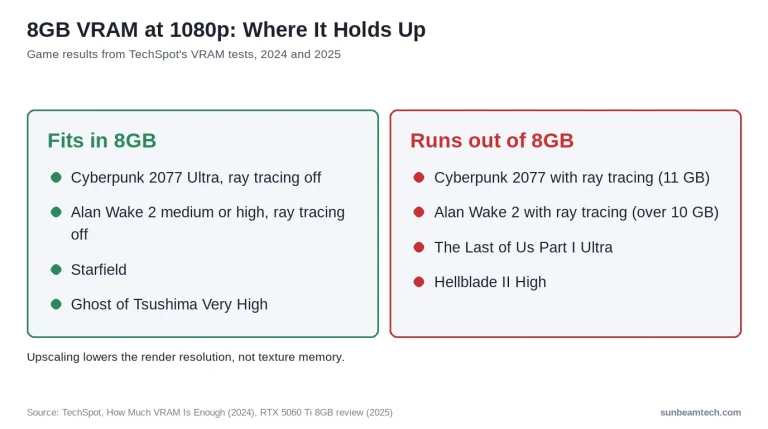
- 8 GB of VRAM is the real limit. Indiana Jones’ minimum spec cards are 8 GB models, and its path tracing mode needs 12 GB. In Flight Simulator 2024, the 16 GB RTX 4060 Ti beat the 8 GB version by 19%. Our guide on whether 8 GB of VRAM is enough for 1080p goes deeper.
The practical takeaway: on a mid-range card, turn on DLSS or FSR at Quality, skip path tracing, and use high rather than max settings. You’ll keep most of the visual quality and a playable frame rate in every game on this list.
Should You Upgrade Your GPU for These Games?
Honestly? Only if the specific games and settings you care about need it.
- You want path tracing at 4K: you’re in RTX 5090 territory, and you’ll still use DLSS. Nothing else gets close in the path-traced games above.
- You want path tracing at 1440p: an RTX 5080 or RTX 4090 with DLSS is the realistic tier, and 16 GB is the minimum VRAM worth buying.
- You play at 1080p or 1440p without path tracing: a current mid-range card with 12 to 16 GB of VRAM handles everything here at high settings with upscaling.
- Your frame rate doesn’t change when you lower settings: upgrade the CPU first, not the GPU.
Frame generation deserves a warning. It makes games look smoother, but it doesn’t make them respond faster. If your base frame rate is below about 40 fps, generated frames won’t fix the feel. Before you commit to long 4K sessions on a card running flat out, it’s also worth knowing what safe GPU temperatures look like under load. And if you’re weighing a step up in the NVIDIA stack, our RTX 4070 vs RTX 4080 comparison shows how much VRAM and RT throughput matter in exactly these games.
The Most Demanding PC Games Through the Years
Every era had its GPU killer. Here’s how the crown moved:
| Era | Most demanding game(s) | Top GPU of the time | Why it hurt |
|---|---|---|---|
| 1999 to 2000 | Quake III Arena, Unreal Tournament | GeForce 256 | Early hardware 3D acceleration pushed to its limits |
| 2004 | Doom 3, Far Cry | GeForce 6800 Ultra | Per-pixel lighting, dynamic shadows, big outdoor spaces |
| 2007 | Crysis | GeForce 8800 GTX | The original “can it run Crysis?” meme |
| 2010 | Metro 2033 | GeForce GTX 480 | DirectX 11 tessellation and heavy post-processing |
| 2013 | Crysis 3 | GeForce GTX Titan | Dense vegetation and advanced lighting |
| 2015 | The Witcher 3 (HairWorks) | GeForce GTX 980 Ti | Strand-based hair and a huge open world |
| 2019 | Metro Exodus, Control | GeForce RTX 2080 Ti | The first mainstream real-time ray tracing |
| 2020 | Cyberpunk 2077 | GeForce RTX 3090 | Dense city with multiple ray-traced effects |
| 2023 | Cyberpunk 2077 RT Overdrive, Alan Wake 2 | GeForce RTX 4090 | Full path tracing arrives in shipped games |
| 2024 to 2025 | Indiana Jones, Black Myth: Wukong, Doom: The Dark Ages PT | GeForce RTX 4090, then RTX 5090 | Mandatory RT, UE5, path tracing updates |
| 2026 | 007 First Light PT, Resident Evil Requiem, Crimson Desert, Control Resonant | GeForce RTX 5090 | Path tracing becomes a launch feature, not a bonus |
Frequently Asked Questions
What is the most demanding PC game right now?
As of September 2026, 007 First Light with its path tracing update is the hardest game to run at max settings. An RTX 5090 drops to around 22 to 25 fps at native 4K. Cyberpunk 2077 in RT Overdrive and Resident Evil Requiem with path tracing are close behind, both below 30 fps on an RTX 5090 at native 4K.
What is the hardest game to run on PC?
Measured by native 4K performance at maximum settings, the hardest games are path-traced ones: 007 First Light, Cyberpunk 2077 RT Overdrive and Resident Evil Requiem. Borderlands 4 is also very hard to run, but mostly because of optimization problems rather than cutting-edge graphics.
Which PC game has the highest system requirements in 2026?
007 First Light’s official path tracing specs are the steepest: an RTX 5070 for native 1080p at 60 fps on PT Medium, an RTX 5080 for 1440p, and an RTX 5090 for 4K on PT High. Control Resonant asks for an RTX 5080 for 4K path tracing.
Can an RTX 5090 run every game at native 4K?
Not at max settings. It stays below 30 fps in several path-traced games at native 4K, and below 50 fps in Borderlands 4 and Control Resonant. With DLSS upscaling it handles everything on this list, but native 4K max with path tracing is still out of reach.
Which games have path tracing?
The main ones are Cyberpunk 2077, Alan Wake 2, Indiana Jones and the Great Circle, Black Myth: Wukong, Doom: The Dark Ages, Resident Evil Requiem, 007 First Light and Control Resonant. See the table above for how each one adds it.
Is Borderlands 4 demanding or just badly optimized?
Mostly badly optimized. It doesn’t use path tracing, yet an RTX 5090 averages around 45 fps at native 4K on the Badass preset, and mid-range cards fall below 30 fps at native 1440p. Lowering the preset and using upscaling helps far more than a GPU upgrade.
What is the most graphically demanding game of all time?
In absolute terms, today’s path-traced games, because they ask more of hardware than anything before. Historically, Crysis (2007) is the most famous GPU killer, and “can it run Crysis?” is still shorthand for extreme hardware demands.
Do I need a new GPU to play these games?
For 1080p or 1440p at high settings without path tracing, usually not, as long as your card has enough VRAM (12 to 16 GB is comfortable, 8 GB is tight). For path tracing, you’ll want an RTX 5070 or better at 1080p and an RTX 5080 or better at 1440p, with upscaling enabled.
Final Thoughts
The pattern for 2026 is clear. Path tracing has moved from tech demo to launch feature, and at native 4K it beats every GPU on the market, including the RTX 5090. If you want to see these games at their best, you’ll use DLSS or FSR. That’s not a failure. It’s how these games are designed to run now.
Two things to watch: GTA 6 is coming, but no GTA 6 PC system requirements exist yet, so ignore anyone claiming otherwise. And upscaling keeps getting better, which matters more for your next upgrade than any single benchmark on this page.

Alex has been building and tweaking custom PCs for over 12 years. From budget builds to full custom water loops, he’s assembled more than 50 systems and helped hundreds of builders troubleshoot their rigs. When he’s not benchmarking the latest hardware, you’ll find him optimizing airflow setups or stress-testing overclocks.